In Japanese there are two names for Fuji when the sun hits it. Akafuji, red Fuji, is the late summer one: the snow has gone, and for a few minutes after sunrise the bare volcanic rock turns a deep brick red. Hokusai printed it that way around 1830, a red cone under a sky full of small white clouds, and it became one of the most copied pictures in the world. Benifuji, crimson Fuji, is the winter one. The mountain is white from the summit halfway down, and when the sun comes up the snow catches it before anything else in the valley does and goes pink, then peach, then gold, while the lakes at its foot are still in shadow.
Codigrate's Fuji theme is that second picture, seen from the shore of one of those lakes, with cherry trees in bloom and a vermilion torii standing at the edge of the water. What follows takes it apart color by color. It is the twelfth nature theme in this series after Aurora Borealis, Everest, Sequoia, Autumn, Roraima, Sakura, Ocean, Salda, Reynisfjara, Spring and Etna, and the tenth premium theme after Ocean, Salda, Prague, Sydney, Reynisfjara, Spring, Vienna, Madrid and Etna. Everest is a mountain too, but in daylight: ice, blue sky and hard shadows. Fuji is the same kind of snow in the ten minutes when it is not white.
A Mountain At First Light
The theme's own description sets the scene: Mount Fuji at first light, the coral peach glow of dawn over snow white, lifted with sakura pink and the vermilion of a torii by the lake. The palette names read like the view from the shore. Snow White, Petal Mist, Petal Peach, Dawn Peach and Coral Sand are the snow as the light reaches it. Ember Coral, Coral Flame, Torii Orange and Terracotta are the sun and the gate. Blossom Pink, Sakura Rose, Mauve Plum and Dusty Rose are the cherry trees. Fuji Teal, Lake Teal and Slate Blue are the water and the side of the mountain the sun has not found yet. And Peach Sand, Clay, Rose Taupe and Sepia Ink are the earth and the ink, the brown line a woodblock print is drawn in.
The interface takes its accents from the gate. Torii Orange #DC5B26 is the accent for links, changed settings, shortcut hints and the letters that match in a completion list, and Coral Flame #F4704D is its second, the color a progress bar fills with and a selected tool window button turns. In the code the work goes to the blossom and the lake: a sakura rose #DD747A for the keywords and a Fuji teal #39A1A5 for everything that belongs to an object.
The Harmony: Pink Snow, Blue Shadow
Snow at sunrise is never one color. Where the low sun reaches it, it takes the warm light and goes pink and peach. Where it does not, in the folds of the mountain and on the slope facing away, it reflects the open sky instead and goes blue. Painters have known this for centuries, and anyone who has stood in front of a snowy mountain at dawn has seen it: warm light, cool shadow, and nothing in between.
Fuji is built on that split. The warm half covers nearly every color in the window. The frame, the panels, the accents, the static members, the attributes and the comments all sit between 12 and 18 degrees on the wheel, the coral and peach of the light. The flowers lean the other way, into pink: keywords at 357 degrees, parameters at 338, the caret at 331 and strings and numbers a mauve at 314. Then, almost straight across the wheel, the cool half: Fuji teal fields and methods at 182, a deeper lake teal for JavaScript member functions at 185 and slate blue local variables at 212. That is a complementary pair, with the warm side much larger than the cool one, the way the lit snow is much larger than the shadow on a morning like that.
Everything is soft. The code colors sit between 25 and 61 percent saturation, and the pinks and the mauve are pastel, which is what makes the theme read as dawn and not as noon. It also means the syntax is quieter on the page than in most light themes, and the theme makes up for it in other ways, which I will come back to.
Backgrounds, From Snow To Dawn
Fuji's backgrounds are four light surfaces, and the further from the code, the more of the sunrise they carry:
- Input #FFFFFF, plain white, for search fields and dialogs.
- Editor #FFFCFB, snow white, the page the code is written on.
- Window #FBEAE3, petal mist, for the tool windows and panels.
- Surface #F5D9D0, dawn peach, the outer frame the whole window sits in.
All of them share one hue, between 15 and 18 degrees, and only the lightness changes: 99 percent for the editor, 94 for the panels, 89 for the frame. The borders and separators use the frame color too, so the panels look cut out of the same peach rather than drawn on top of it. It is the pattern Madrid uses with its saffron walls, but much gentler here: Madrid's frame is a real gold, Fuji's is snow with the sun on it. Hovering a row warms it to #F8E1D9.
Selections follow the light. A selected row in the project tree is petal peach #FBD5C7 edged in ember coral #E39177, and when the window loses focus it cools to #F2E0DA with a coral sand edge #E0C4BB. The blossom comes in where the window points at something. The active editor tab sits on a pale cherry pink #F8D0DF underlined in Blossom Pink #ED84B0, search matches in the interface glow a bright petal #FFB7D3, and selected text in the editor turns pink as well, #FAD1E4, with the code on it still at about 8.9:1.
The editor's own marks come from the rest of the view. Search results in the code are a deep lake blue #1A6D9F on #F8E5DD edged in #1A4E6B, the coldest thing on the page. The word under the caret turns a dark bronze #7A4A12 on #FBE0D6 where it is read, and a shrine gold #B57A1A on #F3E6C8 where it is written to. A matched brace sits on a pale jade #8FC3B0, the one green background in the theme, like the pines along the shore.
The status colors come from around the lake: Shrine Gold #D69A2E for warnings, Pine Green #3E8E5E for success, Fuji Blue #2E7DC4 for information and visited links, and Maple Red #C8453A for errors.
One Foreground, Several Voices
Code is written in Sepia Ink #45302B at about 12:1 against the snow white page, a dark brown rather than a black, the color of the outlines in an old print. Class names, function names and constants keep the same ink, so the names in a file read as the drawing and the colors as what is laid over it. The interface uses the same ink for its labels and, one level down, Rose Taupe #8A6A61 for hints and secondary text, at about 4.8:1 on the editor and 4.2:1 on the panels.
Comments are a warm taupe #94756C at about 4.1:1, a little under the 4.5:1 the readability post suggests for body text, and they are set in italics, line comments, block comments and doc comments alike. The tags inside a doc comment keep the same taupe and turn bold and underlined. So a comment reads as a note in the margin, slanted and brown, and never gets mistaken for code.
This is also where the soft syntax gets its help. On a page this bright, a pastel rose sits at about 3:1,
which is fine for a color you read in passing but light for the word that holds a block together. So Fuji
sets its keywords in bold. The shape of a file, every if, return and class, stands out by weight
first and by color second, and the colors can stay as gentle as the morning they come from.
The gutter is a shade warmer than the page, #FCF5F1. Line numbers are peach sand #C9A08C, quiet at about 2.3:1, and the number on the current line deepens to a burnt terracotta #C46A45. The caret is a blossom pink #D96AA0 over a current row #F7E6DF that is just a touch of dawn on the white. Indent guides are drawn in #EFDCD4, and the guide of the block you are in deepens to #E2C1B5.
Syntax: Blossom, Torii And Lake
Open a file and the view fills in:
- Keywords in bold sakura rose #DD747A, and global variables and HTML and XML tags in the same rose, the blossom over every line.
- Strings, numbers and escapes in mauve plum #BF8AB3, the color of a cherry petal in shade.
- Parameters in dusty rose #B76C88, deeper than the keywords.
- Instance fields and methods in Fuji teal #39A1A5, and JavaScript member functions in a darker lake teal #45888E.
- Local variables in slate blue #5F7D9F, the shadow side of the mountain.
- Static fields and methods in terracotta #D37154, the torii in the morning sun.
- Annotations in a lacquered bronze #A9691F, and attributes in clay #AE8574.
- Class names, function names and constants in Sepia Ink #45302B, and inline hints in Rose Taupe #8A6A61.
Read a few lines and the picture comes together. The structure of the code, its keywords and tags, is the blossom in front. The values are the same blossom in shade. The ink holds the names, and the members you reach into, the fields and methods of an object, are the teal of the lake, the one cool color in a warm file, so that is where the eye stops when it scans a line.
The Final Product
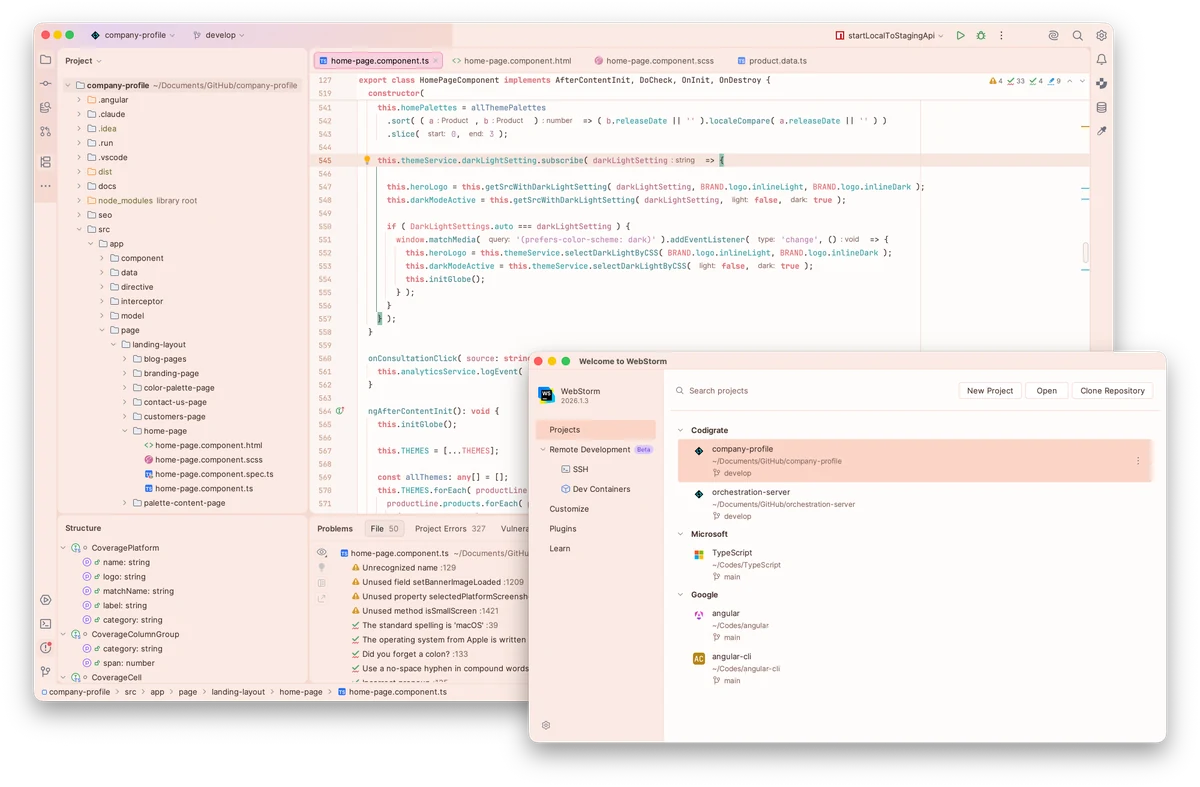
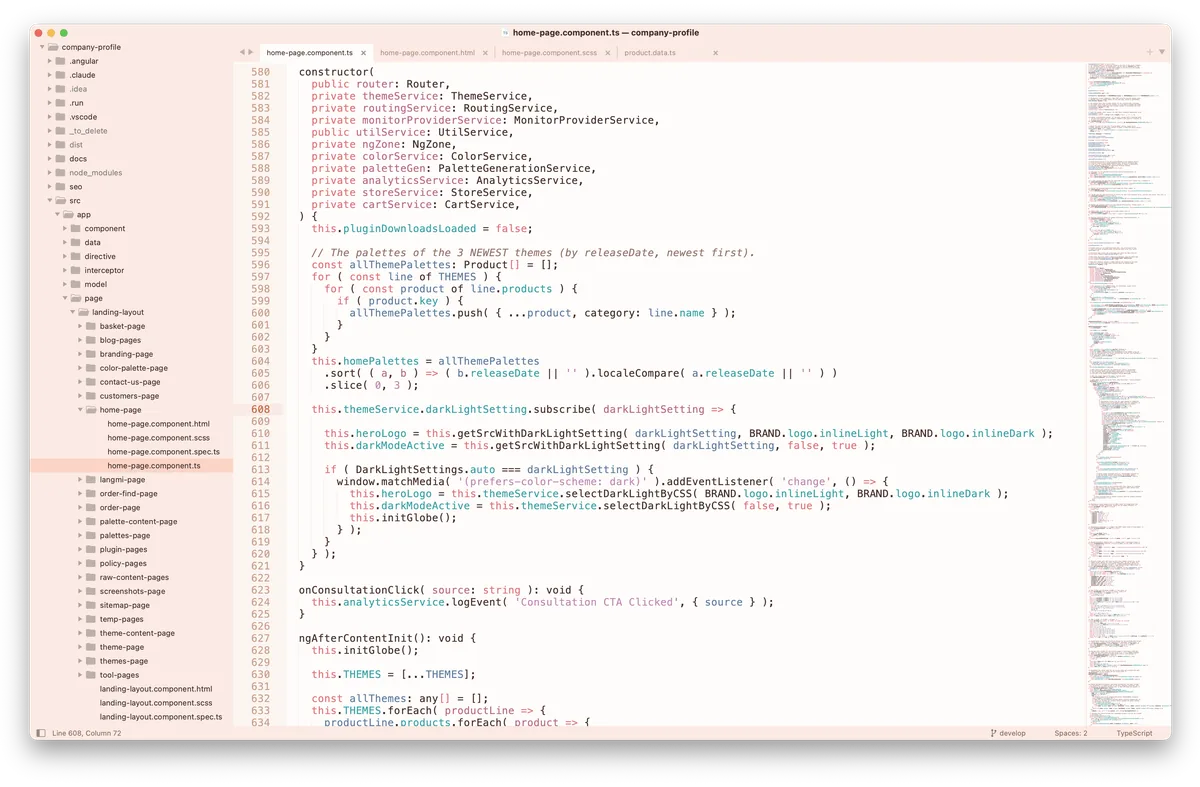
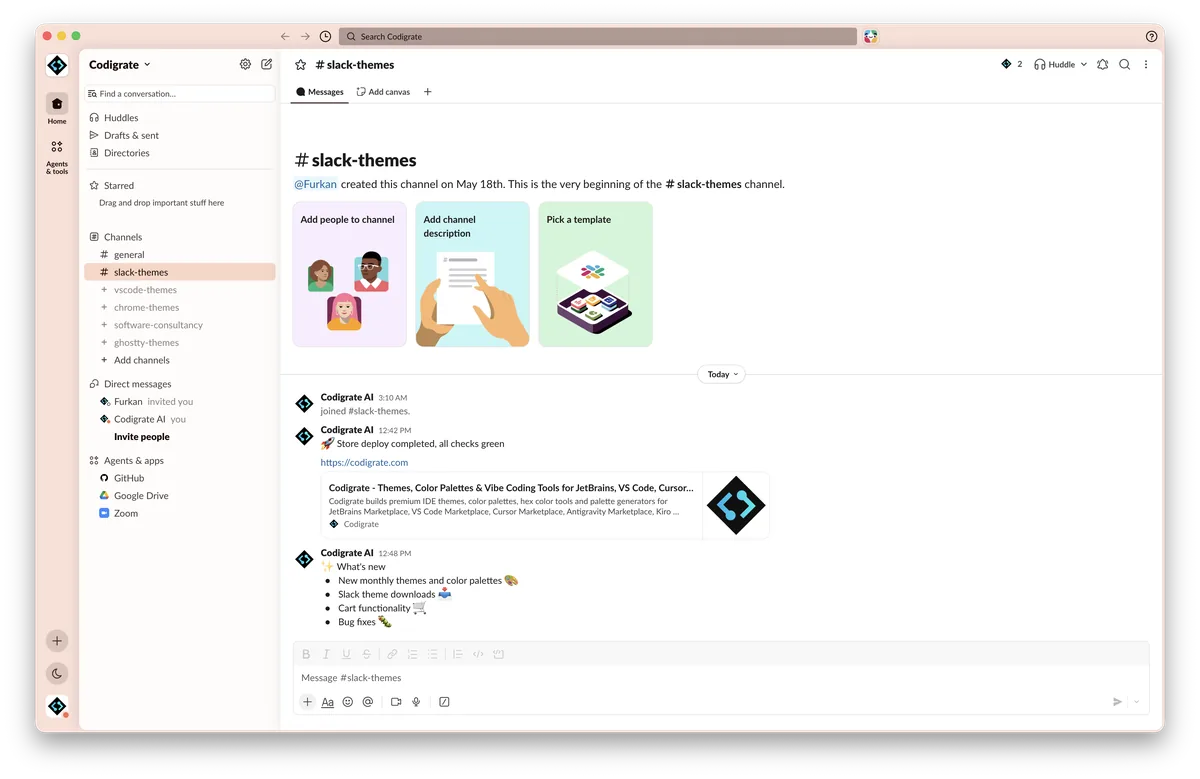
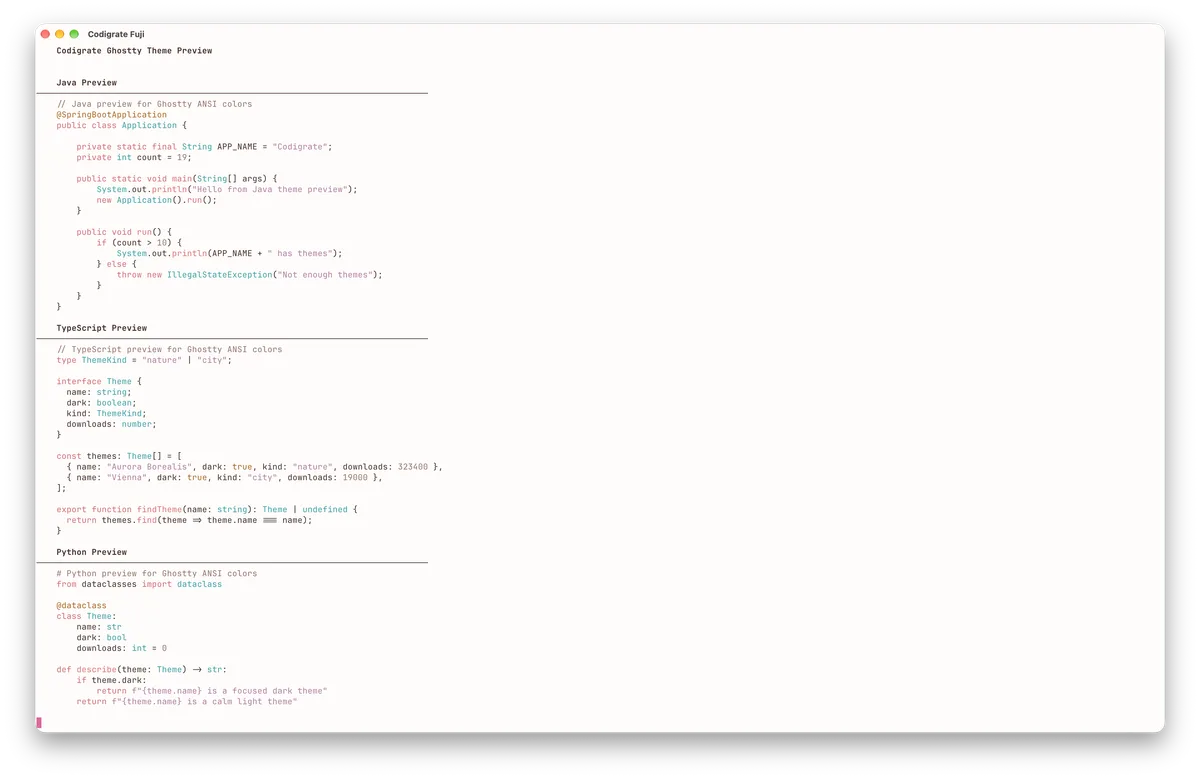
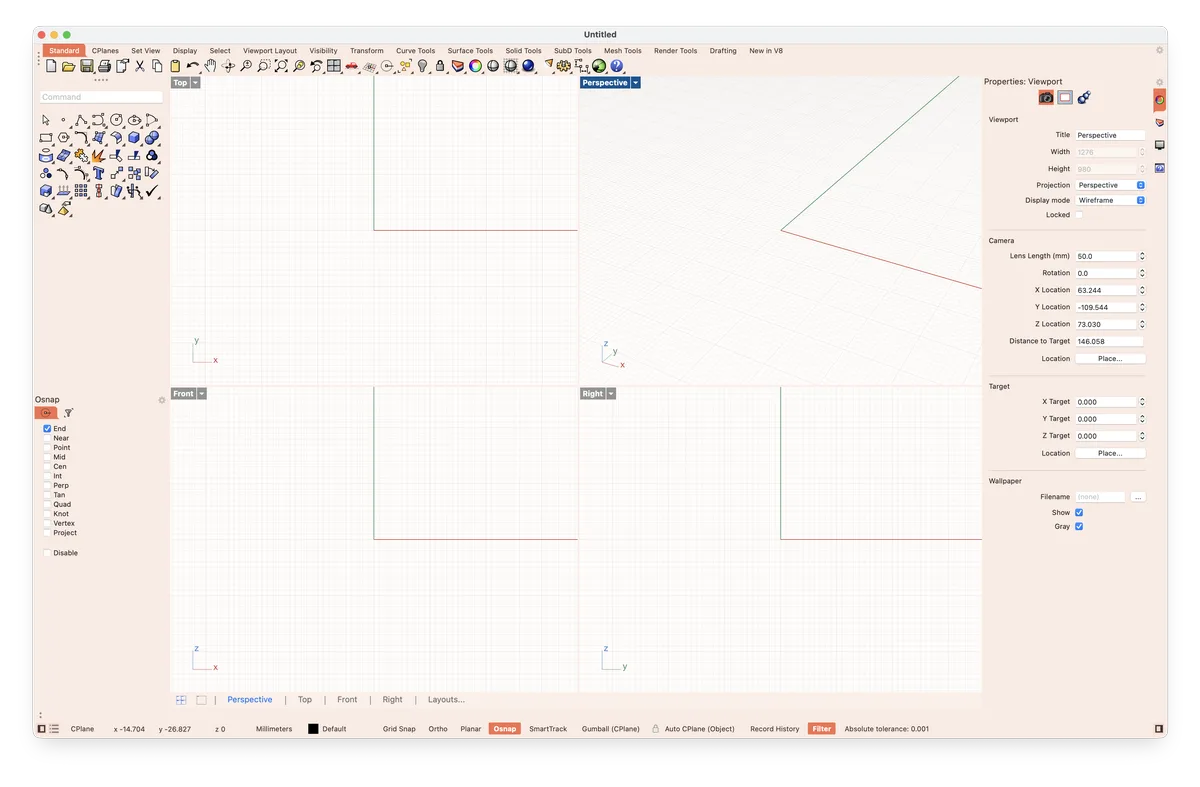
Here is Fuji put back together. The dawn peach frames a JetBrains IDE with a blossom pink tab and Sublime Text keeps the same rose and teal on the same snow. Slack goes peach around the chat with a pink row for the channel you are in, Ghostty prints in rose, mauve and teal on the white page, and in Rhino the viewports turn the pale peach of morning snow, with torii orange marking the active tab and the snaps you have turned on.
Explore Our Themes
Reading It Back
Taken apart, Fuji is a snowfield at sunrise. The backgrounds are the snow, one peach hue that gets stronger toward the edge of the window and fades to almost white where the code is. The syntax is what stands in front of the mountain, cherry blossom in rose and mauve for the structure and the values, a torii terracotta for the static members, and across the wheel the cool teal and slate of the lake for the parts of an object you work with. Bold keywords carry the shape of a file so the colors can stay soft.
It is a theme for early starts and bright rooms, warm without being yellow and pink without being sweet. Fuji is a premium theme: a paid plugin for JetBrains IDEs on the JetBrains Marketplace and part of the All In One bundle, a one time purchase for Xcode, Zed, Sublime Text, Ghostty, iTerm2, macOS Terminal, Claude Code, Slack, Rhino and Firefox from the Codigrate store, and a LINE theme in the LINE theme shop, all from its theme page.
Frequently Asked Questions
What is the Fuji theme?
Fuji is one of Codigrate's premium light nature themes, built around Mount Fuji at first light: the snowcap turning pink in the sunrise, cherry trees in bloom below it and a vermilion torii by the lake. The frame of the editor is the dawn, a soft coral peach, and the code is written on a snow white page. The syntax is the blossom and the lake: sakura rose keywords, mauve plum strings and numbers, dusty rose parameters, with Fuji teal fields and methods and slate blue local variables for the cool notes.
Why is everything in Fuji tinted peach?
Because that is what snow does at sunrise. Every background in Fuji shares one hue, between 15 and 18 degrees on the wheel: the outer frame is Dawn Peach #F5D9D0, the panels Petal Mist #FBEAE3 and the editor Snow White #FFFCFB, almost white at 99 percent lightness. The color gets stronger the further it is from the code, so the window glows around the edge like a snowfield in the first sun, and the page in the middle stays clean and bright.
How are the syntax colors chosen in Fuji?
They split the view into the warm side and the cool side. The warm side is the dawn and the blossom: keywords, globals and tags in sakura rose at 357 degrees, parameters in dusty rose at 338, strings and numbers in mauve plum at 314 and static members in terracotta at 14. The cool side is the lake and the shadow on the snow: fields and methods in Fuji teal at 182 and local variables in slate blue at 212. The two sides sit almost opposite each other on the wheel, so the teal members are easy to find in a pink file.
Where can I get the Fuji theme?
Fuji is a premium theme. On JetBrains IDEs it is a paid plugin on the JetBrains Marketplace and is also part of the All In One bundle. For Xcode, Zed, Sublime Text, Ghostty, iTerm2, macOS Terminal, Claude Code, Slack, Rhino and Firefox it is a one time purchase from the Codigrate store, delivered as a download, and the LINE version is sold in the LINE theme shop. All of them are linked from the Fuji theme page.
