Inspired by the electric nights and pastel sunsets of Miami, this theme blends deep purples with vibrant neon accents to create a bold yet balanced coding environment. Dark, warm backgrounds ground the editor, while vivid pinks, corals, and tropical teals bring energy and clarity to key syntax elements.
A dark theme from the Codigrate Cities collection, released 2026-01-01. Tags: Neon, Tropical, Sunset.
Sold on codigrate.com for $2.99, one payment, tax included: add it to your cart, pay with Stripe (cards, Apple Pay, Google Pay), and download the theme right away. No account needed. Personal licence; a digital download, so all sales are final (see the terms of sale).
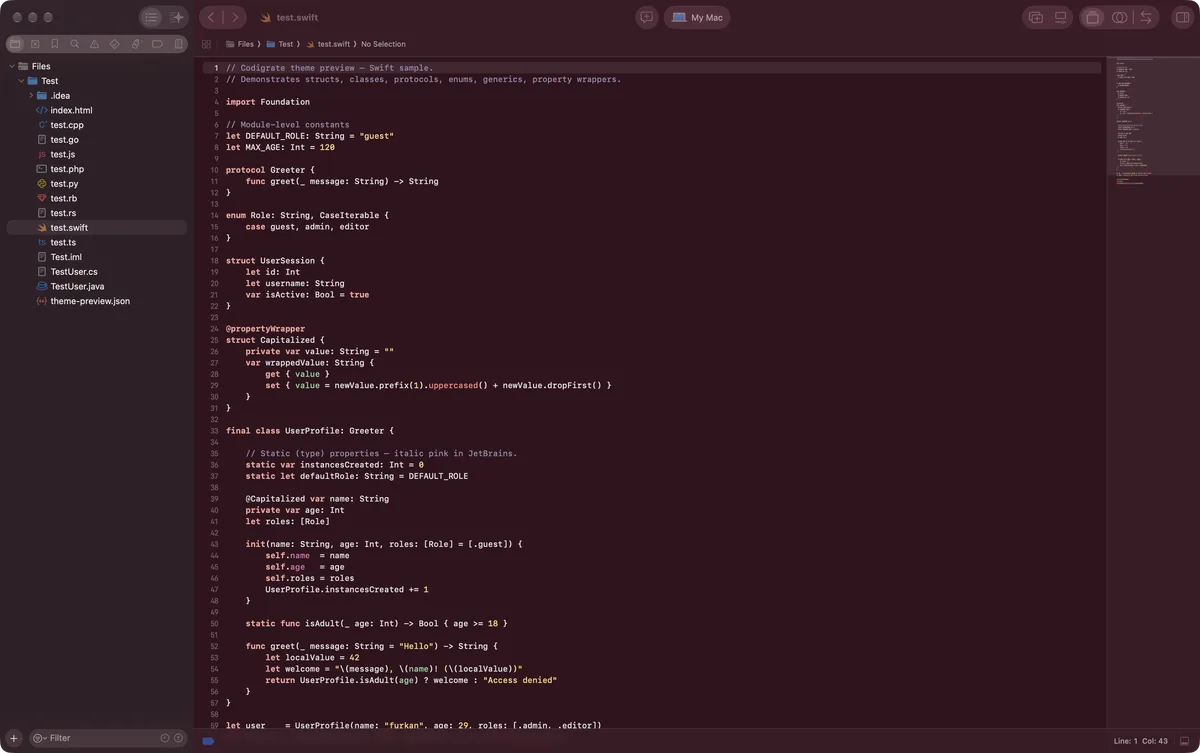
Getting started on Xcode
- Download the zip with the Download button. Inside are two theme files: one for Xcode 26 ( .xcworkspacecolortheme ) and one for Xcode 16 and earlier ( .xccolortheme ).
- Copy both files into ~/Library/Developer/Xcode/UserData/FontAndColorThemes/ ( in Finder, Shift+Cmd+G takes you to the path; create the folder if it is not there ).
- Xcode 26: open Settings → Appearance, click Choose next to Theme and pick the theme under Custom. Xcode 16 and earlier: Settings → Themes lists it after a restart.
- The theme paints the source editor, the console and the documentation view; the window keeps the macOS look.
Miami color palette
Every named color of the Miami palette, free to download for MacOS, CorelDRAW and Figma.
Miami on every platform
- Miami for JetBrains (free)
- Miami for Xcode ($2.99), this page
- Miami for VS Code (free)
- Miami for Chrome (free)
- Miami for Open VSX (free)
- Miami for Slack (free)
- Miami for MacOS Terminal (free)
- Miami for iTerm2 (free)
- Miami for Ghostty (free)
- Miami for Rhino (free)
- Miami for Zed (free)
- Miami for Sublime Text (free)
- Miami for Line
From the blog
- Anatomy of a Dark Theme: Miami: Anatomy of Miami, a dark IDE theme: a raspberry black editor lit by neon pink and sunset coral, cooled by electric aqua, palm green and an art deco blue.
- CMYK: How Four Inks Print Every Color: CMYK reads backwards from every screen model: you start on white paper and subtract light with ink. Why the black K exists, and why neon never quite prints.